
The Chenango County Current Owner Is a Dated Record
The 2026 Norwich assessment roll labels its owner field CURRENT OWNERS NAME. That entry should never stand alone. Read it beside the property location, mailing address, tax-map number, and deed book and page. The roll's taxable-status date is March 1, 2026. Its valuation date is July 1, 2025. Those dates define the snapshot, nothing more. Chenango County publishes no fixed interval for an assessor to refresh the owner field after a deed records. So any current-owner check in Chenango County must compare the newest indexed deed at the County Clerk. Guest access to the Cott index is free. Images and printing require a subscription. The Clerk counter and public terminal offer an alternative route. For an entity owner, check the exact name against the New York Department of State record. For an estate transfer, Surrogate's Court material may matter. Neither source alone supplies a title opinion. So retain the record date and the exact deed citation.
PropertyCheck offers free alerts for later filings tied to a registered name. The alert controls are a notification aid, not proof of present ownership.
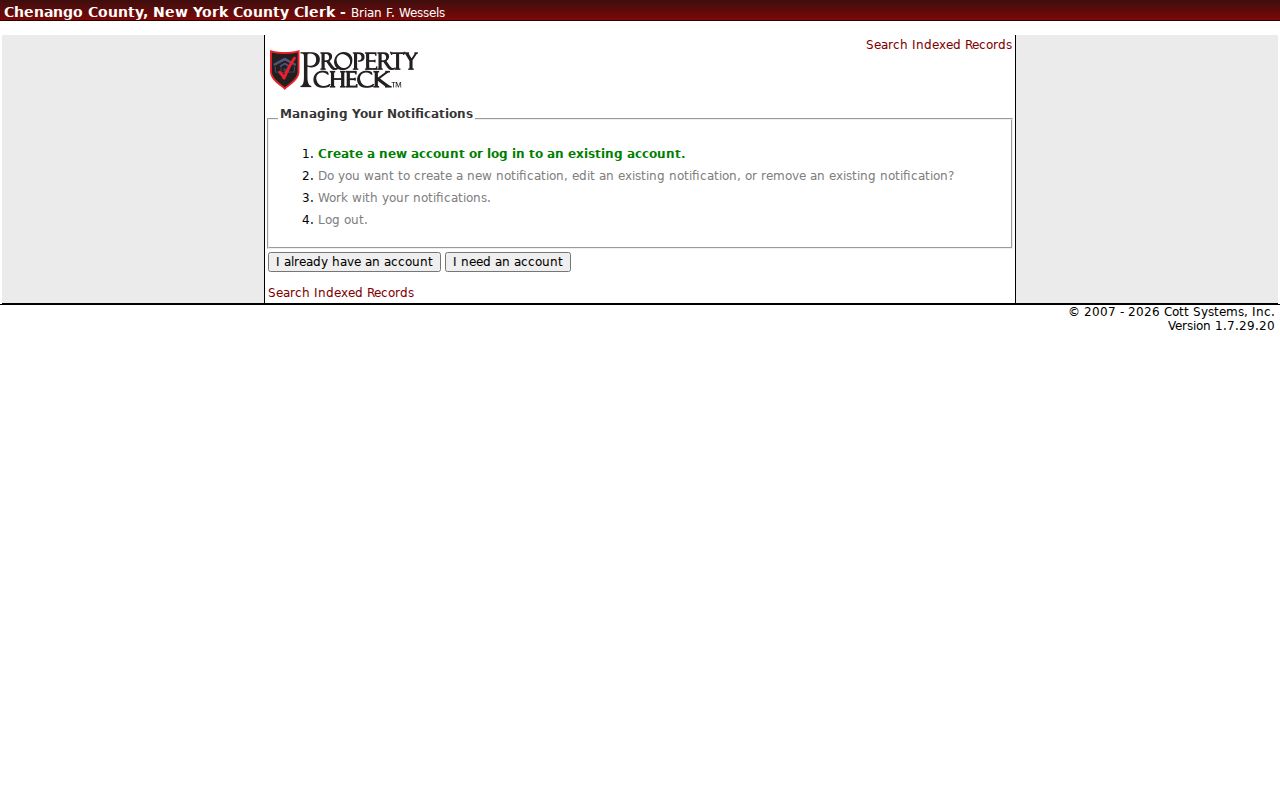
The PropertyCheck alert page displays its notification controls, which serve as a monitoring aid rather than proof of present ownership.
What the Chenango County Current Owner Record Shows
The dated Chenango County source identifies the municipal parcel, its responsible custodian, the available access route, and the record's limits.
| Owner of Record | the dated Chenango County source identifies the municipal parcel, responsible custodian, available access route, and record limits |
|---|---|
| Vesting / Tenancy | the dated Chenango County source identifies the municipal parcel, responsible custodian, available access route, and record limits |
| Mailing Address | the dated Chenango County source identifies the municipal parcel, responsible custodian, available access route, and record limits |
| Situs Address | the dated Chenango County source identifies the municipal parcel, responsible custodian, available access route, and record limits |
| Deed Reference | the dated Chenango County source identifies the municipal parcel, responsible custodian, available access route, and record limits |
| Ownership Since | the dated Chenango County source identifies the municipal parcel, responsible custodian, available access route, and record limits |
The dated Chenango County source points to the municipal parcel, the office that keeps it, the access route, and the limits of the record.
Confirming the Current Owner in Chenango County
To confirm the current owner in Chenango County, the dated source identifies the parcel, custodian, access route, and record limits.
- the dated Chenango County source identifies the municipal parcel, responsible custodian, available access route, and record limits
- the dated Chenango County source identifies the municipal parcel, responsible custodian, available access route, and record limits
- the dated Chenango County source identifies the municipal parcel, responsible custodian, available access route, and record limits
- the dated Chenango County source identifies the municipal parcel, responsible custodian, available access route, and record limits
- Owner of record
- the dated Chenango County source identifies the municipal parcel, responsible custodian, available access route, and record limits
- Vesting
- the dated Chenango County source identifies the municipal parcel, responsible custodian, available access route, and record limits
- Registered agent
- the dated Chenango County source identifies the municipal parcel, responsible custodian, available access route, and record limits
Reaching a Chenango County Property Owner
For reaching a Chenango County property owner, the dated source identifies the parcel, the responsible custodian, the access route, and the record's limits.
Lawful use. the dated Chenango County source identifies the municipal parcel, responsible custodian, available access route, and record limits
Read the Norwich Roll's Current-Owner Fields Together
The clearest local example is the 2026 City of Norwich assessment roll. Its literal label is CURRENT OWNERS NAME. Even so, that field should not be read alone. The same row can supply the property location, the owner's mailing address, tax-map number, property class, land and total assessment, taxable amounts, dimensions or grid references, deed book and page. Full-market value appears there as well. Together those fields separate one parcel from another property held by a similarly named person. The situs is the land itself. The mailing address is simply where assessment or tax correspondence goes. An LLC may receive mail far from Chenango County. An individual owner may use a post-office box or care-of address. None of that establishes who occupies the building. For current-owner work, copy the parcel number and deed citation first. Then confirm the newest conveyance in the County Clerk's index before concluding anything.
Account for the Chenango County Roll's Snapshot Dates
The Norwich roll carries a March 1, 2026 taxable-status date. It also carries a July 1, 2025 valuation date. Those dates explain the assessment snapshot. The county publishes no fixed deadline for owner-field updates. A municipal assessor faces no set number of days after a recording. A recent sale can therefore leave the roll lagging. Compare the roll with Cott rather than declaring one source wrong. Preserve the recording date, the roll year, and the date the property search was performed. Guest access to the Cott index runs without charge. Images and printing require subscription access. A missing image can be pursued at the Clerk's public terminal. It can also be handled at the counter or through a written request. The latest deed's grantee is one strong clue. Its vesting language is another. Together they confirm a recent transfer better than any undated directory entry. Even so, reviewing one deed has limits. It is not the same as examining the full chain or issuing a title opinion.
Verify a Chenango County Entity or Estate Owner
When the roll names an LLC or corporation, use the exact entity name. Search it through the New York Department of State. The state record may return the organization date and status. It may list the county, service address, registered agent, and filing history. Those details help distinguish entities. They add context, too. But they do not identify the beneficial owner of every organization. They do not replace the recorded deed, either. Use the entity spelling exactly as it appears in the land record. Include punctuation variants where necessary.
A trust or estate owner requires a different check. The deed may name a trustee, executor, administrator, or other fiduciary. Chenango County Surrogate's Court at 13 Eaton Avenue maintains estate material. Its holdings include historic probate records dating from 1787. The court publishes no complete public county probate index, though. The relevant file may explain the representative's authority. The conveyance recorded with the County Clerk remains the land-record link. The probate file supplies the supporting authority.
Separate Current Ownership from Value and Occupancy
An owner of record on the Chenango County tax roll is a factual owner. But the roll's numbers answer different questions. The full-market value listed there is not a sale price. The assessed or taxable amount proves nothing about title either. A real transfer price surfaces through RP-5217 and New York's sales-data route. So treat those figures as distinct pieces of the property records picture. An owner name, likewise, never proves who lives at the address.
Put current-owner information to honest uses: property diligence, notice, estate research, and civic transparency. Never use it to harass, threaten, or target anyone. PropertyCheck can send future filing alerts once you create an account and configure notifications. That makes it a solid fraud-awareness tool. It is not a retrospective title search, though. And it cannot prove that no unalerted interest exists. For a transaction, a disputed inheritance, a lien review, or any high-stakes decision, have the complete record examined by the appropriate professional.