
Chenango County Deed Records Start with Instrument Type
Deed records in Chenango County sit among mortgages, assignments, satisfactions, easements, land contracts, liens, filed maps, lis pendens, judgments, and related instruments kept by the County Clerk. The electronic history is advertised back to 1798. The Clerk cautions that not every record is online. Guest index access in Cott is free, but viewing or printing images takes a subscription. Offline routes remain. A public terminal, the counter at 5 Court Street, and a written request with payment and a self-addressed stamped envelope all work.
| Instrument | Research use | Next check |
|---|---|---|
| Deed | Transfer and legal description | Grantor-grantee chain |
| Mortgage or satisfaction | Recorded financing trail | Related document references |
| Easement or map | Access or land layout | Filed map and deed language |
| Lis pendens | Notice tied to litigation | NYSCEF or court clerk |
Current Chenango County Recording Rules Carry 2026 Dates
Current recording rules in Chenango County carry fresh 2026 dates. The revised TP-584 became required March 1, 2026. The County Clerk fee schedule is effective March 30, 2026. RP-5217 accompanies real-property transfers. The county publishes corrective-deed, subdivision-map, and electronic-recording instructions. IT-2663 stays a hard-copy exception in the e-recording guidance. The Clerk's electronic-recording page lists accepted document categories. Verify the live requirements before presenting any document.
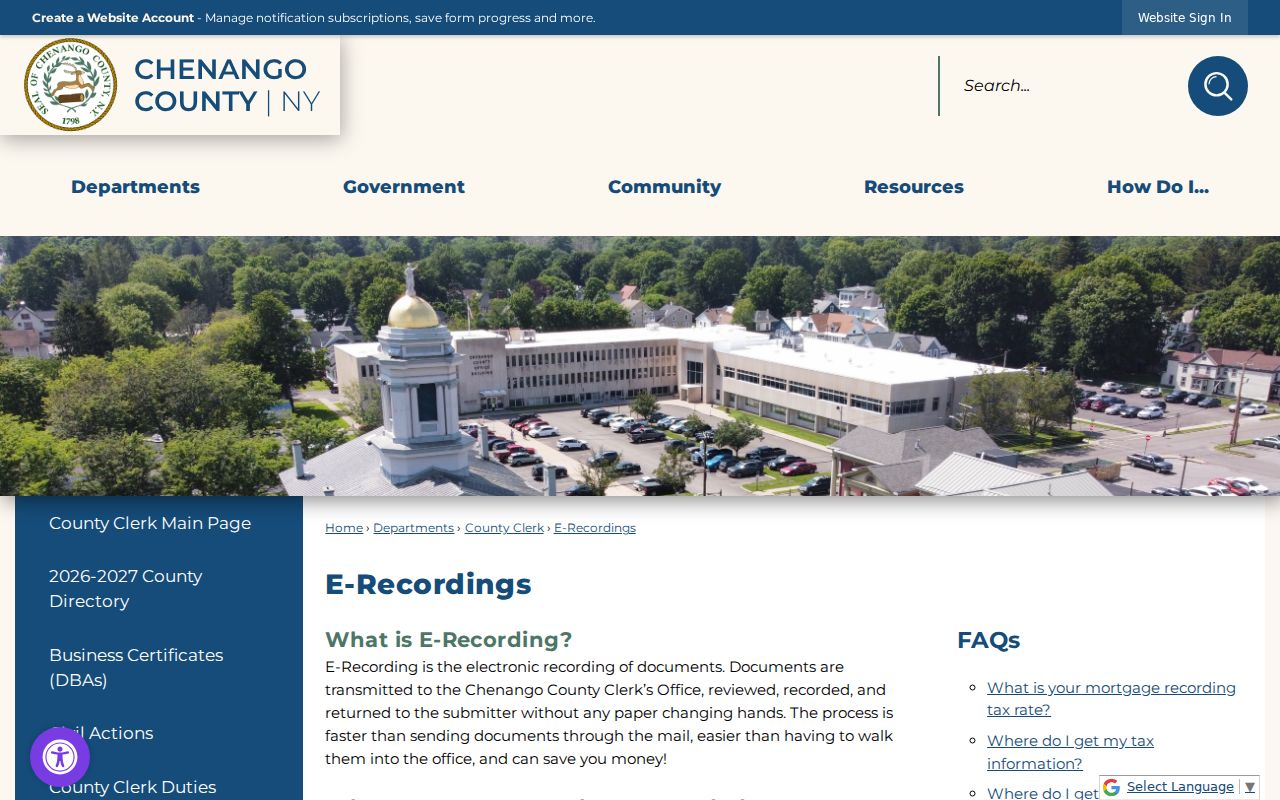
The official Cott page provides the login gateway for Chenango County deed records. Check the county page for later changes.
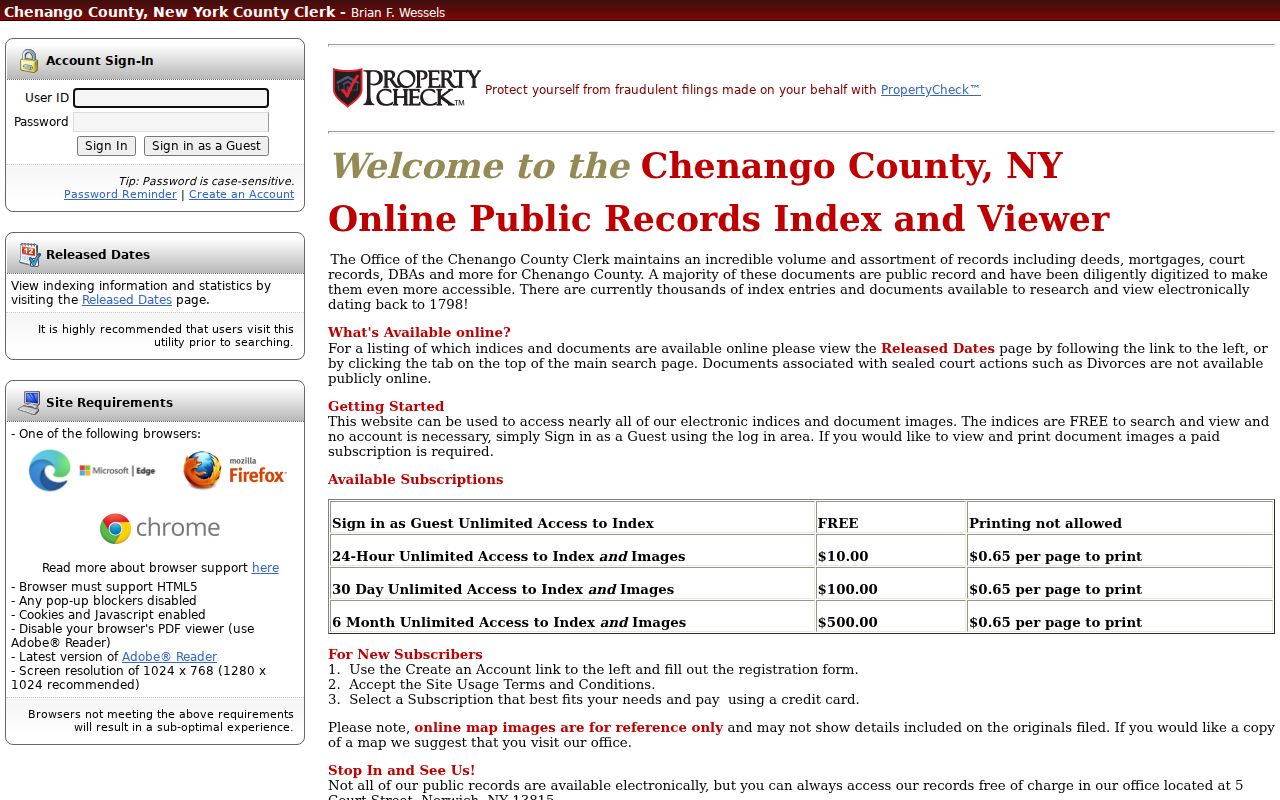
The capture documents the portal entrance, not proof that every historic image is online.
Chenango County Deed Records and What They Show
Each dated Chenango County source names the parcel custodian.
| Deed Type | What It Does | Common Use |
|---|---|---|
| Warranty deed | the dated Chenango County source identifies the municipal parcel, responsible custodian, available access route, and record limits | the dated Chenango County source identifies the municipal parcel, responsible custodian, available access route, and record limits |
| Quitclaim deed | the dated Chenango County source identifies the municipal parcel, responsible custodian, available access route, and record limits | the dated Chenango County source identifies the municipal parcel, responsible custodian, available access route, and record limits |
| Grant / special warranty | the dated Chenango County source identifies the municipal parcel, responsible custodian, available access route, and record limits | the dated Chenango County source identifies the municipal parcel, responsible custodian, available access route, and record limits |
| Trustee / executor deed | the dated Chenango County source identifies the municipal parcel, responsible custodian, available access route, and record limits | the dated Chenango County source identifies the municipal parcel, responsible custodian, available access route, and record limits |
| Tax deed | the dated Chenango County source identifies the municipal parcel, responsible custodian, available access route, and record limits | the dated Chenango County source identifies the municipal parcel, responsible custodian, available access route, and record limits |
The dated source gives parcel, custodian, and access route.
The Chenango County Grantor-Grantee Index
Each dated Chenango County record identifies custodian and access.
- the dated Chenango County source identifies the municipal parcel, responsible custodian, available access route, and record limits
- the dated Chenango County source identifies the municipal parcel, responsible custodian, available access route, and record limits
- the dated Chenango County source identifies the municipal parcel, responsible custodian, available access route, and record limits
- the dated Chenango County source identifies the municipal parcel, responsible custodian, available access route, and record limits
- Grantor
- the dated Chenango County source identifies the municipal parcel, responsible custodian, available access route, and record limits
- Grantee
- the dated Chenango County source identifies the municipal parcel, responsible custodian, available access route, and record limits
- Chain of title
- the dated Chenango County source identifies the municipal parcel, responsible custodian, available access route, and record limits
- Book/Page vs Instrument #
- the dated Chenango County source identifies the municipal parcel, responsible custodian, available access route, and record limits
Getting a Copy of a Chenango County Deed
The source lists the parcel and its responsible custodian.
Recorded, not guaranteed. the dated Chenango County source identifies the municipal parcel, responsible custodian, available access route, and record limits
Start Chenango County Deed Research from the Assessment Roll
A municipal assessment roll removes much of the guesswork from a Chenango County deed search. The 2026 City of Norwich roll shows the pattern. It places a deed book and page beside the tax-map number, property location, mailing address, and CURRENT OWNERS NAME. Copy every field before opening Cott. The book and page give a direct recording reference. The parcel number and location then test whether a same-name result concerns the right land. This helps most with common surnames. It also helps when one owner holds several parcels across Chenango County.
Keep the situs address separate from the tax-mailing address. The Norwich sample includes a Silver Street parcel whose LLC mailing address sits in Valley Stream. That mailing block does not move the parcel. Nor does it change the recording district. Anchor the search to the parcel and legal description instead of the city in an owner's mailing block. The roll is a dated assessment source, not a live recording ledger. Its March 1, 2026 taxable-status date and July 1, 2025 valuation date cannot fix when a newly recorded transfer will appear in the owner field.
Walk a Chenango County Grantor-Grantee Chain Backward
Start with the newest deed. Record the grantee, grantor, recording date, deed type, book and page, and any legal-description clues. Then search that grantor as a grantee. That step finds the deed by which the land was acquired. Repeat for each earlier transfer. Try spelling variants, initials, former surnames, entity names, and both index roles. Check the land description at every link. Without that comparison, a similar name can drag the chain onto the wrong parcel.
A clean line of warranty deeds is never guaranteed. Quitclaim deeds pass only the signer's interest. Executor, administrator, trustee, or other fiduciary instruments may point toward an estate or trust. Chenango County Surrogate's Court can hold probate material on authority. The county publishes no complete online probate index. Mortgages and satisfactions explain financing. They do not transfer the fee interest themselves. Assignments trace a loan, easements affect use, and a lis pendens signals litigation worth checking against NYSCEF or the court clerk.
The County Clerk also serves as clerk of Supreme and County Court. Civil actions begun on or after December 26, 2022 use NYSCEF. Still, a land index and court docket answer different questions. A judgment, satisfaction, or lis pendens near the chain is a prompt, not a verdict; pull the underlying record first, since title is neither clear nor impaired without it and, where needed, professional review.
Use Chenango County's Offline Deed Access When Cott Stops Short
The County Clerk's electronic history stretches back toward 1798. Yet the office itself warns that the online record is incomplete. A missing image does not mean a deed never existed. Note the index citation instead. Then visit a public terminal or the counter at 5 Court Street in Norwich. A written deed-copy request works best when it names the parties and the recording reference precisely. It should include the required payment. It should also follow the Clerk's instructions for a self-addressed stamped envelope. Copy charges come from the fee schedule effective March 30, 2026. An old saved price is not current.
Older land history rewards patience with deed books and the archive. Avoid forcing modern street language onto early entries. The county's historic guide points to survey-map coverage from about 1810. It also lists county atlases dated 1855, 1863, and 1875. Early references can also echo the Clerk's own move from Oxford to Norwich. Two local collections deepen the trail. Guernsey Memorial Library's Local History Room holds newspapers, town histories, and census and cemetery sources. The Chenango County Historical Society's research center holds will directories and Chenango Canal material. Together they can explain a name or a land use. Those sources generate leads. The recorded deed and the map still supply the legal trail in Chenango County property records.
Read Filed Maps Beside Chenango County Deeds
Survey and subdivision maps sit in the Clerk's archive as permanent filed records. Read them beside the deeds. When a Chenango County deed cites a map, subdivision, lot, or earlier instrument, preserve that wording. Then obtain the cited item. The online inventory of named Norwich subdivisions is unclear. Avoid inventing a plat name from a neighborhood label. Start with the parcel-linked citation. Ask the Clerk for the corresponding filed map. Then compare it against the deed description itself.
Image Mate can orient a parcel and reveal abutters. The county states plainly, though, that its tax maps are not boundary surveys. A line on the viewer cannot settle a corner dispute or replace a licensed survey. The Clerk's index is an access tool, not a certification of marketable title. The office also performs no lien searches. A purchase, refinance, contested inheritance, or boundary conflict may still call for a title professional, attorney, or surveyor. That holds true after every public deed record has been collected.