
Search Chenango County Property Records Across the Official Sources
The fastest path depends on the clue you hold. Image Mate accepts an owner, a tax-map number, or a location. The annual assessment-roll PDFs sort everything by municipality. The 2026 City of Norwich roll shows how the pieces connect. Each row pairs a CURRENT OWNERS NAME field with the property location, mailing address, parcel number, class, values, dimensions, grid references, and the deed book and page. That citation opens the door to the Clerk's Cott eSearch index.
Pick the right city, town, or village roll first. Find the address or owner, then copy the tax-map number exactly as written. Cross-check the roll against Image Mate, and carry the deed book and page into Cott. If an image is not online, the Clerk's public terminal still works. So does the counter or a written request. Records that are not posted can also be requested through the county's JustFOIA portal.
Each tool plays its own part. The roll is an assessment snapshot. Cott indexes recorded instruments. GIS supplies tax-map orientation plus abutter context. A tax line is not a survey line. An assessment name can lag behind a fresh deed. An index review is never a professional title examination.
Cott Opens Chenango County's Recorded-Land Trail
The Clerk's electronic deed and mortgage history reaches back to the county's founding in 1798, though not every record is online. Guest index access costs nothing. Images and printing take a subscription, so a researcher can first identify a likely instrument and then decide between paid access, the public terminal, the counter, or a written copy request with payment and a self-addressed stamped envelope.
Search names in both grantor and grantee roles and keep every spelling variant in play. Compare the parcel description or follow the book-and-page trail. Mortgages, assignments, satisfactions, easements, land contracts, liens, filed maps, and lis pendens can all explain a parcel, even when the goal is a single deed. The Clerk does not run lien searches. That limit matters when a transaction calls for professional title work.
Two current dates shape the paperwork. A revised TP-584 became required March 1, 2026, and the posted fee schedule took effect March 30, 2026. RP-5217 accompanies real-property transfers. The county's official real-estate recording page identifies the transfer forms and the subdivision requirements.
Open Chenango County's real-estate recording guidance.
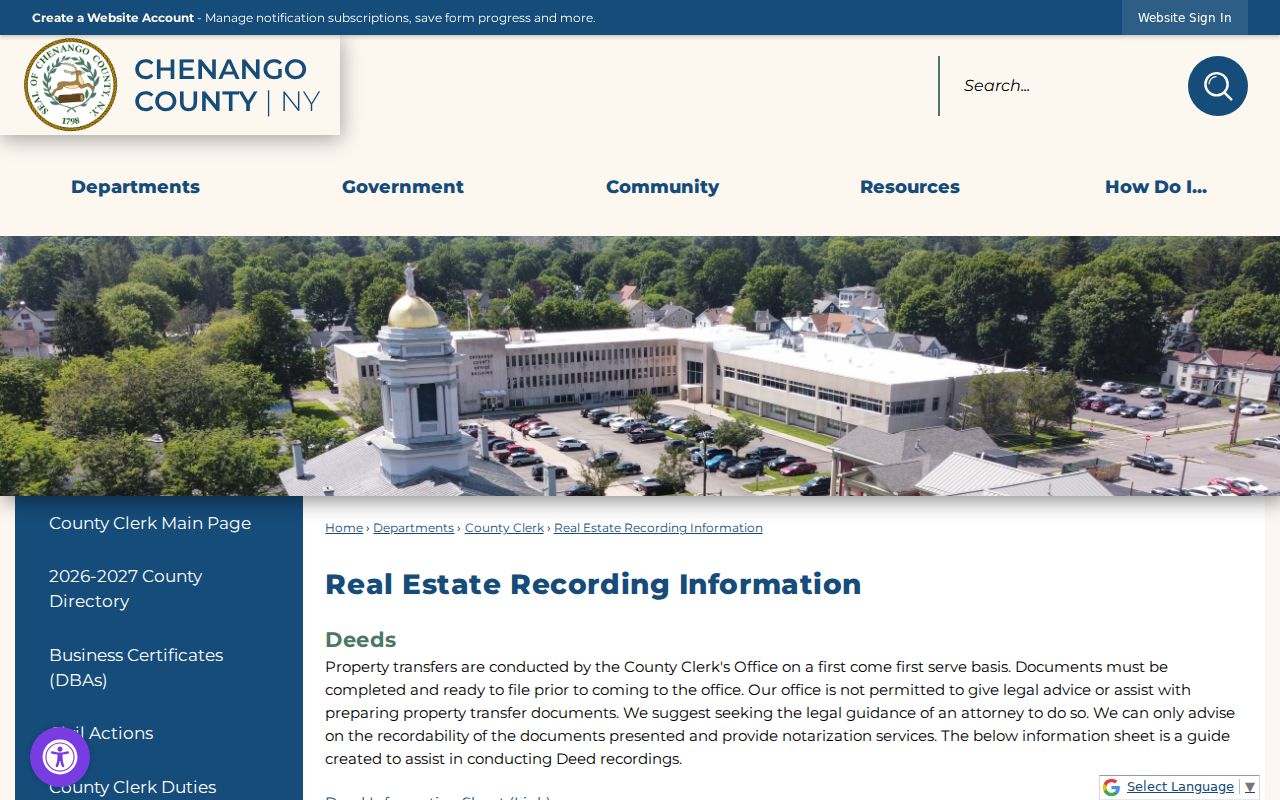
The county's real-estate recording page states the current forms, fees, and subdivision requirements, so check it directly whenever those details change.
The Chenango County Assessment Calendar Fixes the Snapshot
New York runs assessment locally. A Chenango County property search still starts with the right municipality. The county publishes annual roll indexes covering 2020 through 2026. The 2026 Norwich roll carries a March 1, 2026 taxable-status date. It also lists a July 1, 2025 valuation date. Those labels fix when the assessment facts were set. They say nothing about how fast an assessor will pick up a later deed.
March 1 also serves as the exemption date. Tentative rolls come first, then grievance review. Grievance day generally falls on the fourth Tuesday in May. The final roll is dated July 1. Anyone disputing an appraisal should consult the current local calendar and the RP-524 instructions. They should not assume a recording date shifts an assessment deadline.
Parcel: the mapped assessment unit identified by a tax-map number. Assessment: a value used in the tax system. Grantor and grantee: the parties who convey and receive a deed. Plat: a filed map that may depict lots or a subdivision.
Image Mate Adds Chenango County Abutters and Aerial Context
County instructions describe Image Mate searches by owner, tax-map number, or location. The viewer layers in aerial and tax-map context. It identifies parcels, measures, finds abutters, and prints common sizes. That makes it a strong tool. It can move a search from one parcel to the whole block around it. The documented subscription price is $250 per year plus a $25 PIN. Where online access stalls, the county mapping counter remains the practical fallback.
Treat tax maps as reference products, never boundary surveys. A GIS map line can point a deed or survey search in the right direction. But it cannot fix the legal position of a corner. County mapping also sells printed maps and lists a shapefile contact. Parcel, flood, wetlands, and gas-map products are available. When a legal description cites a filed survey or subdivision map, the original sits in the Clerk archive.
Norwich Property Records Require a City-or-Town Check
Norwich is Chenango County's only incorporated city, but the City of Norwich and Town of Norwich are separate jurisdictions. A Norwich mailing label or ZIP code does not settle which roll, code office, or zoning rules apply. Confirm the municipal boundary with the parcel record before choosing an assessor or permit custodian. The 521-page 2026 city roll provides concrete assessment fields, and City Code Enforcement handles the city permit route.
City zoning materials identify R-1, R-1A, R-2, R-3, B-1, B-2, IN, and PUD districts. The permit form asks for site address, tax-map number, flood zone and panel, project value, structure assessment, owner, contractor, insurance information, and an affidavit. No verified public permit-history database was located, so 31 East Main Street and 607-334-1233 are the documented City Code Enforcement fallback.
Historic Chenango County Property Records Form a Time Ladder
Older Chenango County property records reward patience. When the electronic index or the current tax roll runs dry, climb down a time ladder. Do not guess. Start with the newest deed and the modern assessment row. Then work back through earlier deed books and survey maps dating from about 1810. County atlases from 1855, 1863, and 1875 add another rung. Two local archives fill in the human story. Guernsey Memorial Library's Local History Room and the Chenango County Historical Society's James S. Flanagan Research Center hold newspapers, census material, cemetery sources, will directories, town histories, and Chenango Canal records.
The canal ran from 1834 to 1878. It can explain transport, industrial, farm, or water-related clues. History is a lead, not proof. Confirm any easement, boundary, or owner-of-record claim in the recorded instruments and filed maps. One quirk helps: the Clerk's office moved from Oxford to Norwich. So an old courthouse label does not mean the land now sits in a different county.
How to Search Chenango County Property Records
Every Chenango County property search starts with the same four questions. Which municipality holds the parcel? That answer names the custodian, the access route, and the limits of the record.
- the dated Chenango County source identifies the municipal parcel, responsible custodian, available access route, and record limits
- the dated Chenango County source identifies the municipal parcel, responsible custodian, available access route, and record limits
- the dated Chenango County source identifies the municipal parcel, responsible custodian, available access route, and record limits
- the dated Chenango County source identifies the municipal parcel, responsible custodian, available access route, and record limits
- the dated Chenango County source identifies the municipal parcel, responsible custodian, available access route, and record limits
Chenango County Property Records Offices
Each Chenango County office answers for its own parcels, so the municipality decides the custodian, the access route, and the record limits.
Chenango County Recorder / Register of Deeds
5 Court Street
Norwich, NY 13815
607-337-1450
Chenango County Assessor / Appraisal District
5 Court Street
Norwich, NY 13815
607-337-1450
Chenango County Treasurer / Tax Collector
5 Court Street
Norwich, NY 13815
607-337-1450
Types of Chenango County Property Records
Chenango County property records span deeds, assessment rolls, parcel maps, and tax files, each held by its own custodian.
| Record Type | What It Documents | Kept By | Access |
|---|---|---|---|
| Deeds | ownership transfers and deed dates | Chenango County Clerk | free guest index; paid images |
| Mortgages & liens | recorded financing and claims | Chenango County Clerk | free guest index |
| Tax & assessment | assessment values and exemption fields | municipal assessor and tax collector | published roll |
| Plats & parcels | tax-map context and filed maps | Real Property Tax Services and County Clerk | county viewer |
| Building permits | documented permit applications | City or County Code Enforcement | office request |
Deed records, assessment rolls, plats, and tax bills make up the core Chenango County record types, and access rules differ for each.
What Chenango County Property Records Can and Cannot Tell You
Chenango County records show ownership, parcels, and value, yet every access route has limits worth knowing up front.
Lawful use. the dated Chenango County source identifies the municipal parcel, responsible custodian, available access route, and record limits
Use Chenango County's Offline Record Routes
Online access is only part of a Chenango County property search. Cott allows free guest index access. Images and printing take a subscription. If an indexed deed image is missing, visit the County Clerk's public terminal or counter at 5 Court Street. Mailing works too. Send a written request with party names, the recording citation, payment, and a self-addressed stamped envelope. The Clerk's electronic deed and mortgage history reaches toward 1798. Not every record is posted. So a gap online never proves the instrument does not exist.
Assessment runs through city, town, and village assessors. County Real Property Tax Services provides support. Current tax balances stay with the collector who issued the city, town, village, or school levy. Delinquent county tax questions belong to the Treasurer's delinquent-tax office. Permits have a split map. County Code Enforcement serves most jurisdictions. It does not cover the Town and Village of Greene, the Village of Earlville, or the City of Norwich. Norwich city parcels go to City Code Enforcement instead.
Some county records are simply not posted. Chenango County's JustFOIA portal offers a request route for those. It runs under New York's Freedom of Information Law. Name the record type, parcel, date range, and any citation you have. FOIL covers records an agency already holds. It cannot force an office to draft a title opinion. It cannot rebuild a boundary or run open-ended research.
Separate Chenango County Assessment, Tax, and Sale Figures
Assessment, taxable value, full-market value, and sale price answer different questions. The numbers sit side by side in a parcel record, but they are not interchangeable. The 2026 Norwich roll applies a 040.00 uniform percent. Even so, its full-market field is no guarantee of the actual sale price. For a true transfer figure, use RP-5217 filings and New York Sales Web. Equalization rates compare municipal assessment levels. They are not parcel appraisals. Historical tax-rate files explain levies without proving payment. Before trusting any figure, match the municipality, roll year, exemption columns, collector, and tax period.
Connect Chenango County History Back to Recorded Evidence
PropertyCheck sends free alerts on later filings once you set up an account. For older digging, three sources carry the load. The Clerk archive, Guernsey Memorial Library, and the Chenango County Historical Society hold deep historical material. Survey maps date from about 1810. County atlases from 1855, 1863, and 1875 help place early farms and roads. The Chenango Canal ran from 1834 to 1878 and often explains transport or industrial clues. Treat all of it as a trail, not a verdict. Historical material earns weight only when it leads back to deeds, easements, and filed maps.
Court notices belong with NYSCEF or the court clerk. An estate transfer may need Surrogate's Court authority. These layers make Chenango County property records rich. They also explain why a careful answer draws on several custodians rather than one search box. Cite each source with its date, parcel key, and access limit. That way anyone can retrace the path.
Always retain the office name, record date, and exact parcel citation used.